
How drug companies are using polymorph patents to lock up psychedelic knowledge.
America is witnessing a surge in psychedelics bioprospecting and research. According to Psychedelic Alpha, there are 59 clinical trials using psychedelic agents right now, including ten in Phase 3. Americans are likely to see the first FDA-approved versions of psilocybin- and LSD-based treatments within a year. Treatments based on toad venom (5-MeO-DMT) and the West African iboga root (ibogaine) could be up for FDA approval within the coming years. The medicalization and commercialization of naturally occurring and other psychedelic substances is underway—and drug companies are poised to own everything that comes out of it.
In this newsletter, we break down how companies are using a tried-and-true big pharma patenting tactic to fence off psychedelic knowledge. Here’s what you need to know about polymorph patents in the psychedelic market.
Patenting the Results of Routine Testing
Chemical compounds can exist in two or more crystalline forms known as polymorphs. To receive FDA approval, drug companies must screen for polymorphs and prove they can control which one ends up in their treatment. Scientists typically find these variants by using automated screening platforms, subjecting a drug to standard temperature and solvent tests, selecting the most stable form, and proving they can reproduce it.
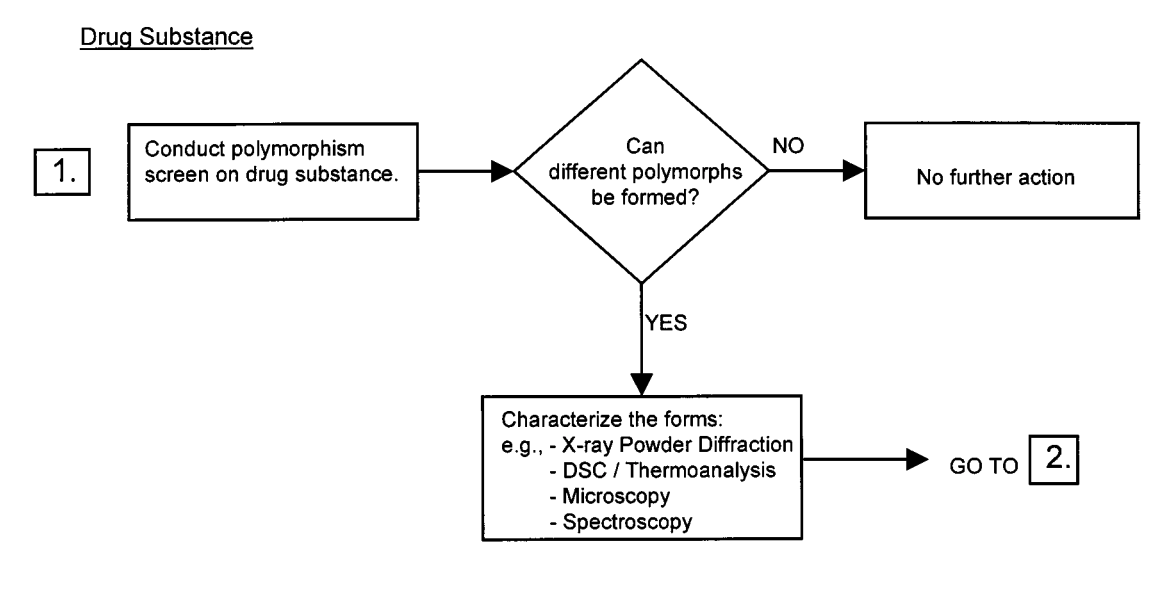 Decision Tree #4 from the FDA’s guidance on polymorph screeningThis screening and control testing is paint-by-numbers science: the FDA even provides guidance to the industry, including a list of standard testing techniques and a decision tree. Yet despite the routine and automated nature of this work, the patent office (USPTO) treats polymorphs as inventions and allows companies to patent them.
Owning Psilocybin
Psilocybin is the compound that makes certain mushrooms psychoactive. Mesoamerican cultures have used it in spiritual and religious ceremonies for thousands of years. Albert Hofmann first isolated and synthesized psilocybin in 1958 while working at Sandoz, which went on to obtain two patents: US3183172 and US3192111. Both expired more than 40 years ago. Crucially, those patents covered methods of extracting and administering psilocybin, not the compound itself. As a naturally occurring substance, psilocybin should be unpatentable.
Despite all this, Compass Pathways is expected to launch COMP360, a patent-protected psilocybin medicine, in the United States in the first half of 2027. Compass has secured various patents on a particular shape of the psilocybin compound, which it calls Polymorph A. Once COMP360 is approved, Compass can list those patents in the FDA’s Orange Book and every generic manufacturer will have to fight through them or design around them before entering the market. In its investor deck, Compass projects that these patents will allow it to maintain a monopoly on its psilocybin treatment until 2038, nearly eighty years after Albert Hofmann and Sandoz filed their first patents on psilocybin. Compass may also hold non-Orange Book listed patents and applications, which could be used to extend its monopoly even longer.
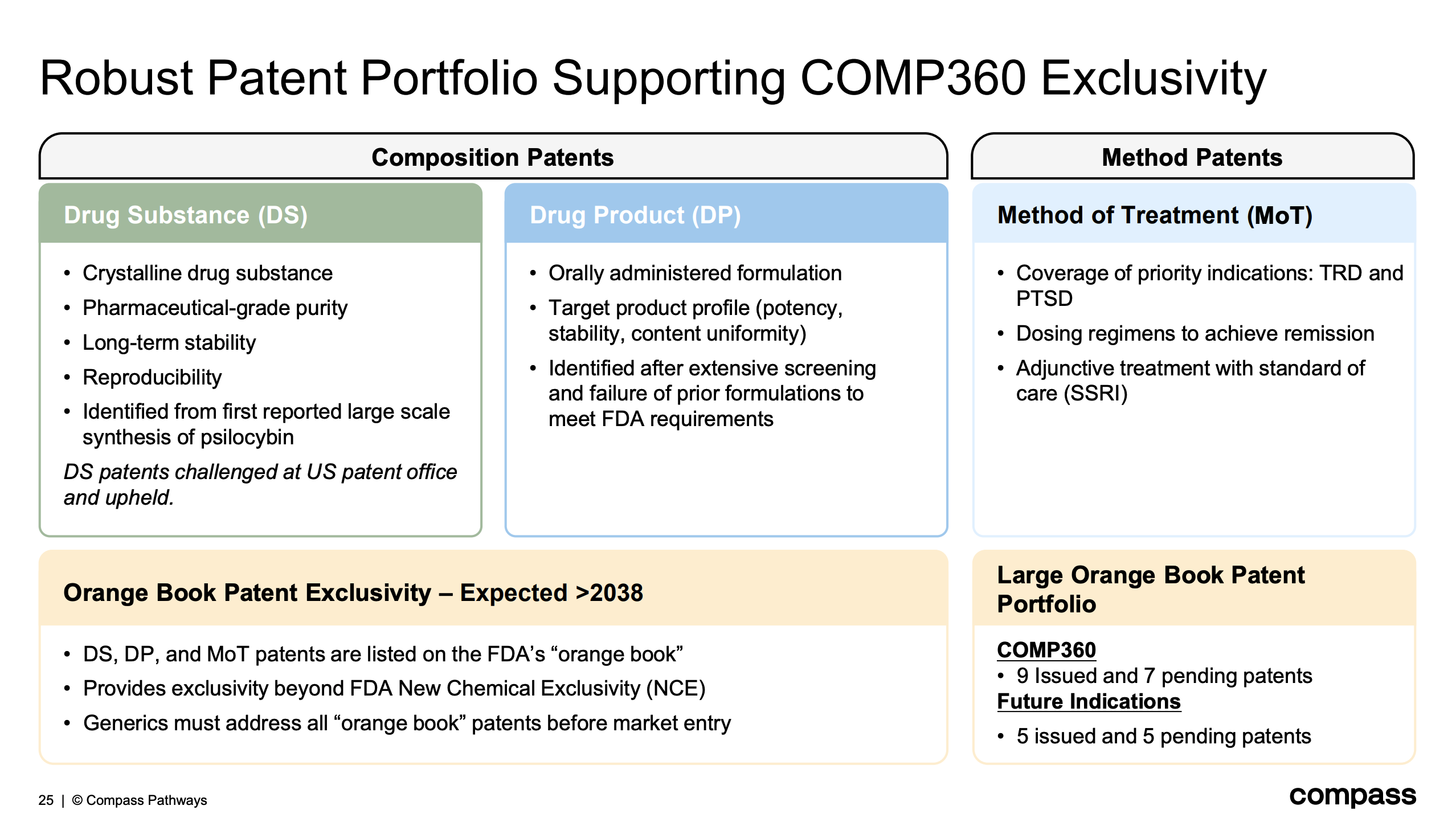
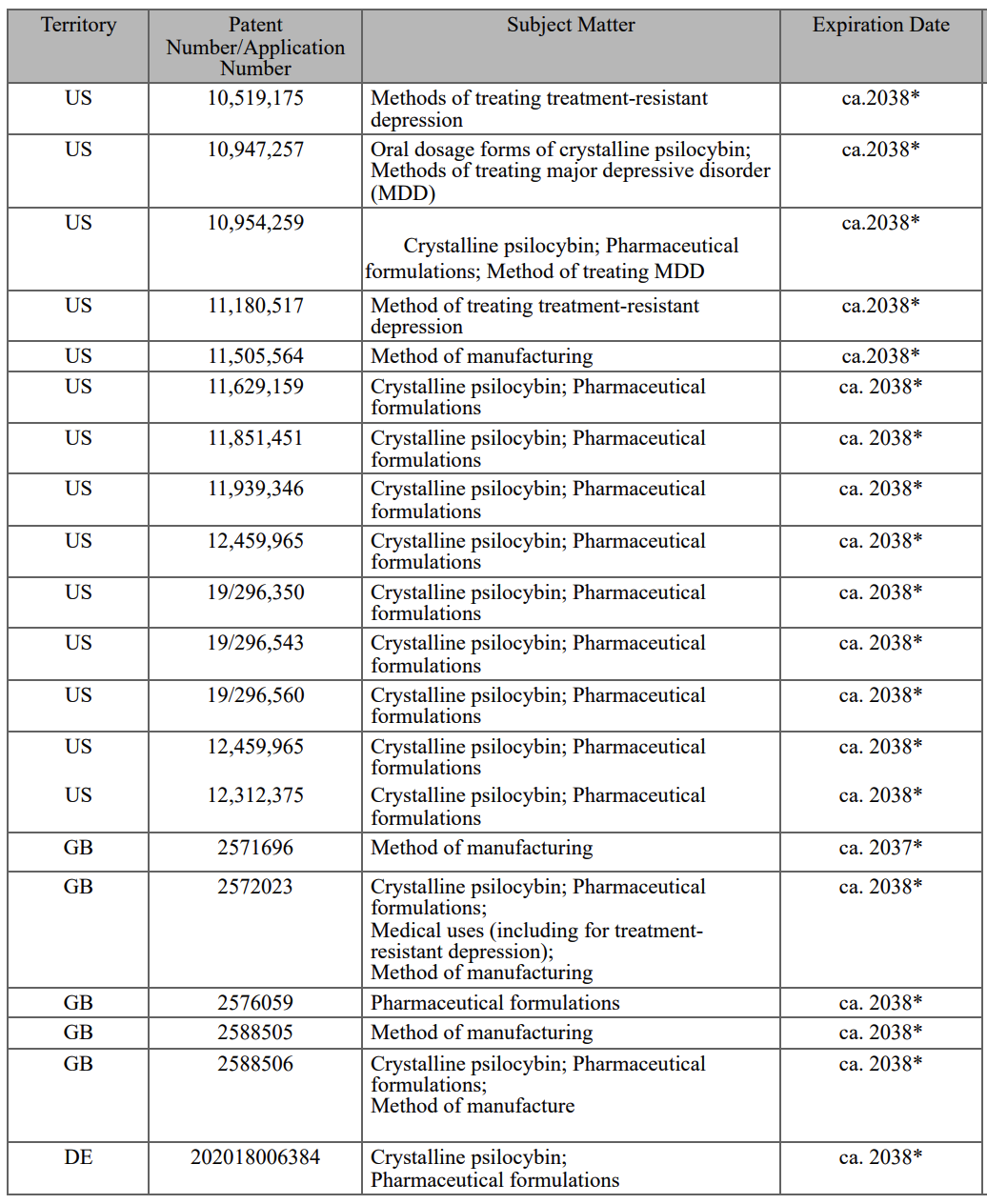 Compass’s 2026 investor deck (p.25). Patent table excerpt from Compass’s 2025 10-K (p.28).
In a 2022 interview with VICE, Compass co-founder George Goldsmith was asked whether he really believed Compass’s form of psilocybin is novel and non-obvious (and therefore worthy of the patents Compass has been granted). “It doesn’t really matter what we believe,” he said. “We have the granted patents.”
 VICE News segment “The Battle Over Psychedelic Therapy’s Future,” January 2022
Owning LSD
Albert Hofmann first synthesized lysergide (LSD) in 1938, two decades before he synthesized psilocybin in the same Sandoz lab. Extensive research was conducted on LSD throughout the 1950s and 1960s: more than a thousand peer-reviewed papers were published on it before the Controlled Substances Act shut the work down in 1970. LSD is 88 years old and has been described in the open literature for most of that time.
Definium Therapeutics is nevertheless preparing to launch a patent-protected LSD treatment called DT120 ODT that features LSD D-tartrate (the same salt form of LSD that Hofmann synthesized and Sandoz patented decades ago) pressed into a fast-dissolving tablet. Definium has reported positive Phase 3 clinical trial results in major depressive disorder and generalized anxiety disorder, and is likely to submit for FDA approval late this year or early-2027.
 Definium Investor & Analyst Deck (p.60)Sandoz’s patents on LSD D-tartrate, like its patents on synthetic psilocybin, expired long ago. But just like Compass, Definium is using polymorph patents to own it anyway. In 2022, Definium applied for a patent on a polymorph of LSD D-tartrate. Four years later, in January 2026, the USPTO granted it. The polymorph patent family is a key part of the patent stack that Definium expects to last until at least 2043.
Polymorphs Should Not Be Patentable
Corporations are racing to own and financialize naturally occurring and other psychedelic substances, many of which Indigenous communities have preserved and used for millennia. This bioprospecting and biopiracy should trouble all of us, and deserves its own discussion. Today, however, we’re showing why polymorphic forms of psychedelics should not be patentable.
Compass Pathways projects exclusivity on its psilocybin-based treatment until at least 2038. Definium projects exclusivity on its LSD-based treatment until at least 2043. Neither company claims they’ve developed a new compound. Instead, they claim they’ve discovered a polymorph, a particular crystalline form the old compound takes in the tablet. Polymorphs are the result of standardized, FDA-mandated screenings. The FDA rightfully treats polymorph identification as routine science. But the USPTO treats the same work as invention/discovery worthy of monopoly protection. The FDA and USPTO must collaborate to ensure that routine science is not treated as patent-worthy invention/discovery.
The Medication Affordability and Patent Integrity Act, sponsored by Senators Maggie Hassan (D-NH) and Josh Hawley (R-MO), would help bridge the FDA and USPTO’s communication gap. The bill essentially requires companies to certify that what they tell the FDA is consistent with what they tell the USPTO; for enforcement, it provides a defense to allegations of patent infringement by said companies and further makes failure to disclose consistent information a “prohibited act” under the Food, Drug, and Cosmetic Act.
However, unsurprisingly, the bill has been watered down in its most recent version. Still, it represents a meaningful step forward. Another bill, the Interagency Patent Coordination and Improvement Act, would only set up a task force. It would impose no duty on patent applicants and no penalty for continuing to exploit information asymmetries between agencies.
Congress should pass the Medication Affordability and Patent Integrity Act—but that is only the first step. As we state in our Blueprint and in my submission at the USPTO-FDA Listening Session in 2023 (page 86), ultimately, Congress needs to pass legislation making polymorphs obvious and, therefore, unpatentable.
By Tahir Amin
Co-Founder and CEO, I-MAK